
Hyundai Venue (QX): Seat Belt Restraint System / Seat Belt-Driver’s 3-point system with emergency locking retractor
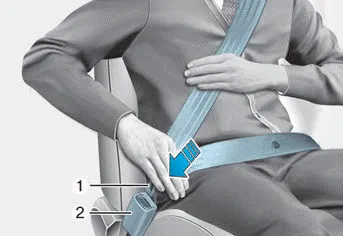
To fasten your seat belt:
Pull the seat belt out of the retractor and insert the metal tab (1) into the buckle (2). There will be an audible “click� when the tab locks into the buckle.

You should place the lap belt (1) portion across your hips and the shoulder belt (2) portion across your chest.
The seat belt automatically adjusts to the proper length after the lap belt portion is adjusted manually so that it fits snugly around your hips. If you lean forward in a slow, easy motion, the belt will extend and move with you.
If there is a sudden stop or impact, the belt will lock into position. It will also lock if you try to lean forward too quickly.
NOTICE
If you are not able to smoothly pull enough of the seat belt out from the retractor, firmly pull the seat belt out and release it. After release, you will be able to pull the belt out smoothly.
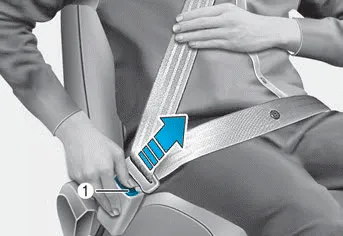
To release your seat belt:
Press the release button (1) in the locking buckle.
When it is released, the belt should automatically draw back into the retractor. If this does not happen, check the belt to be sure it is not twisted, then try again.
WARNING Improperly positioned seat belts may increase the risk of serious injury in an accident. Take the following precautions when adjusting the seat belt: Position the lap portion of the seat belt as low as possible across your hips, not on your waist, so that it fits snugly.
This type of seat belt combines the features of both an emergency locking retractor seat belt and an automatic locking retractor seat belt. Convertible retractor type seat belts are installed in the rear seat positions to help accommodate the installation of child restraint systems.
Other information:
Hyundai Venue (QX) (2020-2026) Service Manual: Immobilizer Control Unit. Repair procedures
Removal 1. Disconnect the negative (-) battery terminal. 2. Remove the glove box. (Refer to Body - "Glove Box Housing") 3. Remove the smart key unit (A) after loosening the nuts.
Hyundai Venue (QX) (2020-2026) Service Manual: Head Lamp Leveling Switch. Repair procedures
Inspection 1. Disconnect the negative (-) battery terminal. 2. Remove the crash pad lower panel (A). (Refer to Body - "Crash Pad Lower Panel") 3. Remove the crash pad lower switch (A).
Categories
- Manuals Home
- Hyundai Venue Owners Manual
- Hyundai Venue Service Manual
- Front Suspension System
- Maintenance
- Instrument Cluster
- New on site
- Most important about car
